
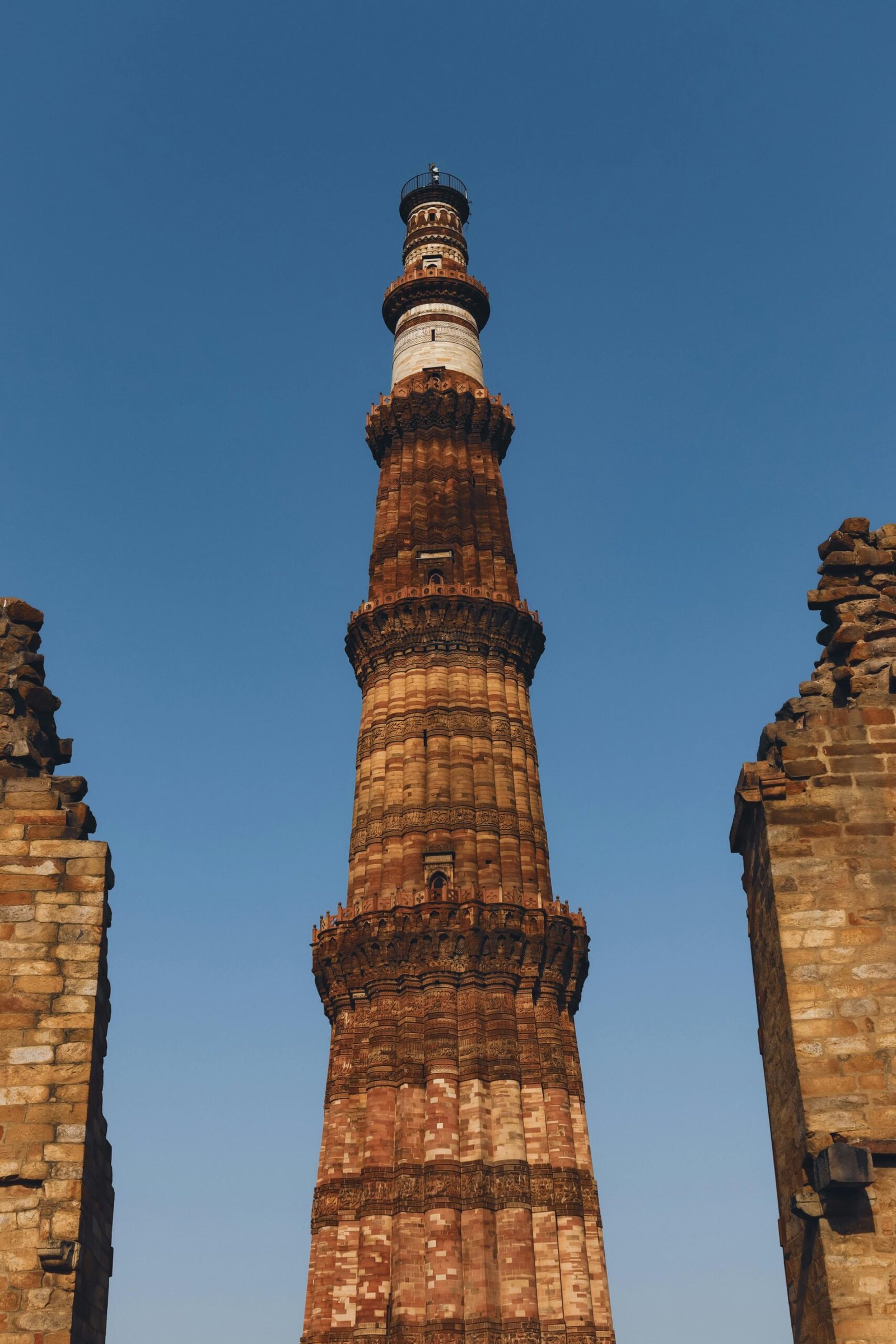
Qutub Minar, located in the Mehrauli area of Delhi, is one of India’s most iconic historical monuments and a UNESCO World Heritage Site. Rising to a height of 73 meters, it is the tallest brick minaret in the world and a striking example of early Indo-Islamic architecture. Built in the late 12th and early 13th centuries, Qutub Minar reflects the beginning of Muslim rule in India and stands as a powerful symbol of the country’s layered history.
Construction of Qutub Minar was initiated in 1193 by Qutb-ud-din Aibak, the founder of the Delhi Sultanate, shortly after his victory over the last Hindu kingdom of Delhi. The minaret was intended to serve both as a victory tower and as a minaret from which the call to prayer (azan) was given. After Aibak’s death, the structure was continued by his successor Iltutmish, who added three more storeys. Later, Firoz Shah Tughlaq rebuilt the topmost storey after it was damaged by lightning, giving the monument its present form.
Architecturally, Qutub Minar is a masterpiece. It is constructed mainly of red sandstone, with marble used in the upper levels. The tower has five distinct storeys, each marked by a projecting balcony supported by intricately carved brackets. The surface of the minar is adorned with detailed carvings, geometric patterns, and verses from the Quran inscribed in Arabic calligraphy. These inscriptions not only enhance its beauty but also provide insight into the artistic and religious influences of the time.
The Qutub Minar complex includes several other historically significant structures. Among them is the Quwwat-ul-Islam Mosque, one of the earliest mosques built in India, made using materials from demolished Hindu and Jain temples. Another major attraction is the Iron Pillar, famous for its rust-resistant composition, which has puzzled scientists and historians for centuries. Together, these monuments make the complex a rich archaeological and cultural site.
Over the centuries, Qutub Minar has survived natural calamities such as earthquakes and lightning strikes, undergoing multiple restorations. Despite this, it has retained its grandeur and continues to attract millions of visitors from around the world. Climbing inside the minar is no longer permitted for safety reasons, but visitors can admire its towering presence from the surrounding gardens.
Today, Qutub Minar is more than a historical monument—it is a reminder of India’s diverse cultural heritage and architectural brilliance. Surrounded by lush lawns and ancient ruins, the site offers a peaceful contrast to the bustling city of Delhi. Whether viewed as an architectural wonder, a historical landmark, or a cultural symbol, Qutub Minar remains an essential stop for anyone exploring India’s past and its enduring legacy.