
History of Jaipur
Jaipur, the capital city of Rajasthan, is one of India’s most historically rich and culturally vibrant cities. Known today as the “Pink City”, Jaipur has a unique history that blends royal vision, scientific planning, and Rajput valor.
Jaipur was founded in 1727 by Maharaja Sawai Jai Singh II, the ruler of Amber. Before Jaipur, the capital of the kingdom was Amber (Amer), located a few kilometers away. Due to increasing population, water scarcity, and the need for a well-planned capital, Sawai Jai Singh II decided to establish a new city. What made Jaipur remarkable was that it became India’s first planned city.
Sawai Jai Singh II was not only a warrior king but also a scholar with deep interest in astronomy, mathematics, and architecture. He consulted Bengali architect Vidyadhar Bhattacharya, who designed Jaipur according to the principles of Vastu Shastra and Shilpa Shastra. The city was laid out in a grid pattern with wide streets, strong fortifications, and well-defined residential and commercial zones—an advanced concept for its time.
Jaipur was strategically located on major trade routes connecting Delhi, Agra, Gujarat, and other parts of northern India. This helped it grow rapidly as a center of trade, commerce, and craftsmanship. The city became famous for gemstones, jewelry, textiles, and handicrafts, many of which are still associated with Jaipur today.
During the 18th and early 19th centuries, Jaipur emerged as a powerful Rajput state. Despite the decline of the Mughal Empire, Jaipur maintained relative stability through diplomacy and military strength. In 1818, Jaipur became a princely state under British suzerainty through a treaty with the British East India Company. While the rulers retained internal autonomy, they accepted British supremacy.
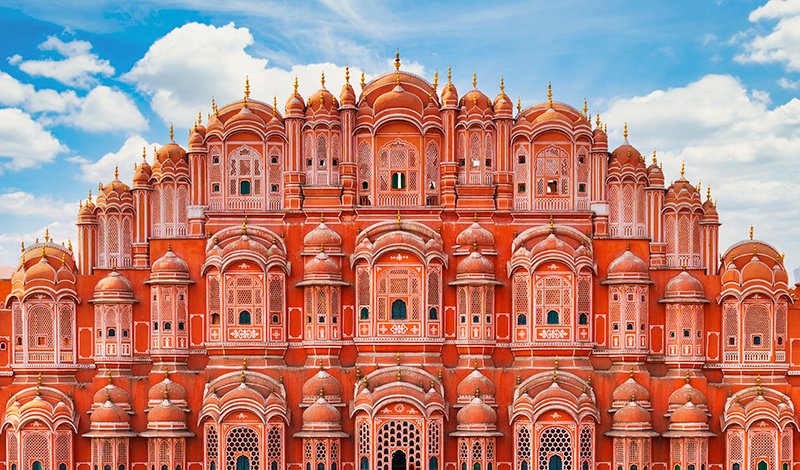
Under British rule, Jaipur continued to develop. Railways, modern administration, and educational institutions were introduced. One of the most iconic moments in Jaipur’s history occurred in 1876, when the entire city was painted pink to welcome Prince Albert, the Prince of Wales. Pink symbolized hospitality, and since then, Jaipur has been known as the Pink City.
Jaipur is also known for its magnificent architecture. Landmarks such as City Palace, Hawa Mahal, Jantar Mantar, Amber Fort, Jaigarh Fort, and Nahargarh Fort reflect a blend of Rajput, Mughal, and European styles. The Jantar Mantar, built by Sawai Jai Singh II, is a UNESCO World Heritage Site and showcases India’s advanced astronomical knowledge in the 18th century.
After India gained independence in 1947, Jaipur was merged into the newly formed state of Rajasthan in 1949 and was declared its capital. The role of the Maharaja ended, but Jaipur continued to grow as an administrative, educational, and cultural center.
Today, Jaipur is a major tourist destination, attracting visitors from all over the world. It represents the grandeur of Rajasthan’s royal past while embracing modern development. The city stands as a testament to visionary planning, royal heritage, and centuries of historical evolution.
In essence, the history of Jaipur is the story of a city built with foresight—a place where tradition and modernity coexist, and where the legacy of Rajput rulers continues to shape its identity.
Places to Visit in Jaipur
- Hawa Mahal
- Place2
Leave a Reply